|
|
|
All over the world, Auschwitz has become a symbol of terror, genocide,
and the Holocaust. It was established by the Nazis in the suburbs of the
city of Oswiecim which, like other parts of Poland, was occupied by the
Germans during the Second World War. The name of the city of Oswiecim
was changed to Auschwitz, which became the nam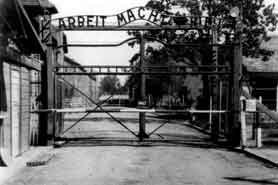 e
of the camp as well. June 14, 1940, when the
first transport of Polish political prisoner deportees arrived in
Auschwitz, is regarded as the date when it began to function. e
of the camp as well. June 14, 1940, when the
first transport of Polish political prisoner deportees arrived in
Auschwitz, is regarded as the date when it began to function.
Over the following years, the camp was expanded and consisted of three
main parts:
Auschwitz I,
Auschwitz II-Birkenau, and
Auschwitz III-Monowitz. It also had over 40
sub-camps. At first, Poles were imprisoned and died in the camp.
Afterwards, Soviet prisoners of war, Gypsies, and prisoners of other
nationalities were also incarcerated there. Beginning in 1942, the camp
became the site of the greatest mass murder in the history of humanity,
which was committed against the European Jews as part of Hitler's plan
for the complete 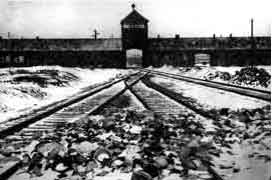 destruction
of that people. The majority of the Jewish men, women and children
deported to Auschwitz were sent to their deaths in the Birkenau
gas chambers
immediately after arrival. At the end of the war, in an effort to remove
the traces of the crimes they had committed, the SS began dismantling
and razing the gas chambers, crematoria, and other buildings, as well as
burning documents. destruction
of that people. The majority of the Jewish men, women and children
deported to Auschwitz were sent to their deaths in the Birkenau
gas chambers
immediately after arrival. At the end of the war, in an effort to remove
the traces of the crimes they had committed, the SS began dismantling
and razing the gas chambers, crematoria, and other buildings, as well as
burning documents.
Prisoners capable of marching were
evacuated into the depths of the Reich. Those who remained behind in
the camp were
liberated by Red Army soldiers on January 27, 1945. A July 2, 1947
act of the Polish parliament established the Auschwitz-Birkenau State
Museum on the grounds of the two extant parts of the camp, Auschwitz I
and Auschwitz II-Birkenau.
|
|
|
|
|