
In mitosis, eukaryotic cell nuclei divide to form two nuclei, each containing a complete set of the cell's chromosomes. It undergoes many stages before it can divide. [see more]





|
|
|
|
In mitosis, eukaryotic cell nuclei divide to form two nuclei, each containing a complete set of the cell's chromosomes. It undergoes many stages before it can divide. [see more] |
|
||||||
|
|
|||||||||
|
|
|||||||||
|
|
|
|||||||||
|
Parent Cell
 |
dna replicationChromosomes are not yet visible in the parent cell (the single, beginning cell) because they are extended and uncoiled. The DNA of each chromosome is copied. Each chromosome consists of two identical strands.Since each daughter nucleus (the splitting cells) must receive a copy of each chromosome, DNA must replicate before mitosis can begin. |
|
|
prophase (considered to be the first stage of mitosis)Mitosis begins. The chromosomes coil into short, fat rods. The nucleur envelope breaks up. A network of protein cables called spindle fibers assemble across the cell. |
 |
metaphaseThe nucleur membrane diminishes completely. Chromosomes attach to the spindle fibers and line up in the center of the cell. |
 |
anaphaseEach chromatid separates from its identical copy. Chromosomes are pulled to opposite sides of the cell. The spindle fibers begin to break down. At the end of anaphase, each opposite side contains a complete cluster of chromosomes. |
 |
telophaseEach side of the cell now has a complete set of chromosomes. A nucleur envelope forms around each new set of chromosomes. The chromosomes uncoil so that proteins can be built. The spindle fibers disappear. |
|
Two Daughter Cells
|
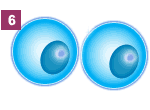
cytokinesis (cell division)The cytoplasm is pinched in half, forming two new cells. These two cells are referred to as the daughter cells. Each new cell contains identical DNA with its own nucleus. After growth and replication, the cells repeat process 2-6 and divide again. |
In summary, mitosis occurs in a 3-step fashion:
|